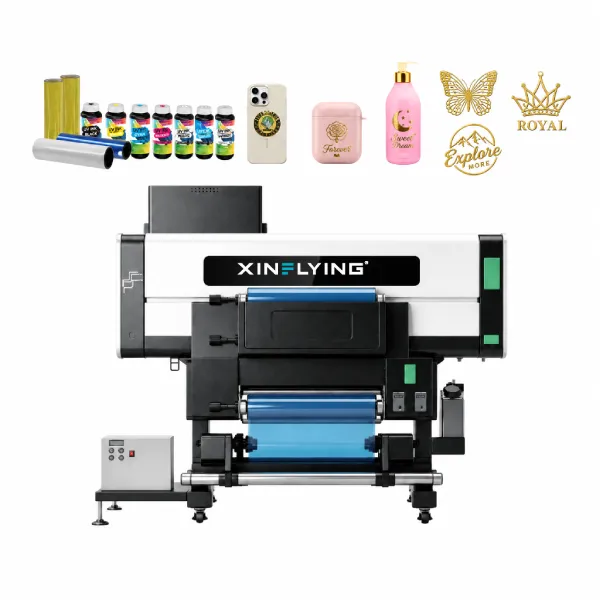
UV DTF printing has become an increasingly relevant option for businesses serving customized packaging, promotional products, giftware, labeling, and premium branding markets. Unlike a purchasing decision based only on initial machine price, selecting a UV DTF printer for sale requires buyers to examine production capacity, print configuration, automation, workflow compatibility, and the type of value-added effects the equipment can produce.
For print service providers, label manufacturers, packaging specialists, and customized product businesses, the right machine should fit both current order requirements and future growth plans. A reliable evaluation process can help reduce the risk of purchasing equipment that looks attractive on paper but does not match real production conditions.
Start With the UV DTF Printer Manufacturer and Product Range
The first step is to understand the capabilities and positioning of the UV DTF printer manufacturer. Buyers should look beyond a single model and examine whether the supplier offers a broader range of digital printing equipment and solutions.
Xinflying, for example, presents a portfolio that includes DTF printers, UV DTF printers, DTG printers, sublimation printers, and related consumables. Its UV DTF lineup includes models with different print widths, printhead configurations, productivity levels, and specialty printing capabilities. This broader product range can help commercial buyers compare equipment according to production requirements rather than applying a one-size-fits-all approach.
The supplier’s support structure also deserves attention. For business buyers, installation guidance, remote technical assistance, operator training, access to consumables, and after-sales communication can influence long-term equipment utilization. This company states that it provides professional after-sales support, remote technical assistance, and online training for its digital printing solutions.
Check Print Width Against the Actual Order Mix
Printing width directly affects the size of transfers that can be produced and the amount of material that can be processed across the machine. A narrow-format system may suit smaller personalized items, while wider equipment can provide greater flexibility for larger graphics and more efficient production layouts.
The XF-600ST has a 60 cm, or 24-inch, printing width. This format is designed to support larger transfer designs and can be relevant for businesses handling premium labels, customized gifts, packaging graphics, and branded decorative applications.
However, wider capacity should not automatically be treated as the only purchasing advantage. Buyers should compare print width with available floor space, expected media consumption, order volume, and the size of typical customer artwork. The best match is the one that supports the actual production mix without creating unnecessary equipment costs or underutilized capacity.
Evaluate Printhead Configuration and Productivity Together
Printhead configuration is another critical factor when evaluating a UV DTF printer for sale. The number and type of printheads can affect productivity, print configuration, and maintenance requirements, but buyers should consider these factors alongside the stated production speed rather than in isolation.
The XF-600ST uses four Epson i3200-U1 printheads and has a listed productivity of 5.5 m²/h at 6-pass printing. The combination is intended for commercial UV DTF production where throughput and specialty output are both important.
Purchasing teams should also clarify how speed figures are measured. Pass settings, image coverage, resolution, color configuration, operator workflow, and finishing steps can all influence real production output. Comparing machines using the same or similar production conditions provides a more meaningful basis for equipment planning.
Assess Whether Specialty Effects Create Additional Business Value
Standard color printing may not be sufficient for every market. Businesses serving cosmetics, fragrances, jewelry, boutique products, premium gifts, or high-end packaging may need decorative effects that help labels and branding materials stand out.
This is where specialty capabilities can become an important buying criterion. The XF-600ST combines color printing with integrated gold foil stamping. Its official specification lists the color configuration as W+CMYK+V, together with an integrated foil-stamping function for metallic decorative effects.
For business buyers, the question is not simply whether a machine can produce an eye-catching finish. It is whether that capability can support target applications, expand the service portfolio, or help meet customer demand for higher-value customized products. Specialty functions should therefore be evaluated against expected sales opportunities and production complexity.
Examine Workflow Automation and Production Stability
A printer’s productivity depends on more than print speed. Manual handling between stages can slow production, increase labor requirements, and create more opportunities for alignment or handling errors.
The XF-600ST is positioned as an all-in-one system that automates printing, foil transfer, waste discharge, and laminating within one workflow. Xinflying also lists a large-capacity ink system with stirring and low-ink alerts, along with water-cooled UV curing lamps and intelligent bottom heating. These features are intended to support more consistent operation during commercial production.
Buyers should examine the entire production sequence, including media loading, printing, curing, laminating, transfer preparation, and finished-output handling. Automation should be assessed according to whether it removes meaningful production bottlenecks rather than simply adding features to a specification sheet.
Review Installation Requirements and Operating Conditions
Commercial equipment must also fit the planned production environment. Buyers should confirm machine dimensions, electrical requirements, environmental conditions, and the space required for material handling and maintenance access.
This company lists the XF-600ST machine dimensions as 1850 × 990 × 1610 mm, with a net weight of 400 kg. The specified operating temperature range is 20–30°C, with relative humidity of 45%–65%. The listed power supply supports 220V/110V and 50Hz/60Hz, with a current specification of 11.3A.
These specifications should be checked before purchase against the intended production site. Facility readiness is particularly important for businesses installing equipment into existing printing operations where power availability, environmental control, access routes, and available floor space may already be constrained.
Making a More Informed UV DTF Equipment Investment
Evaluating a UV DTF printer for sale should involve more than comparing headline prices or maximum print speeds. Print width, printhead configuration, productivity, specialty effects, automation, curing systems, operating conditions, and supplier support should all be considered as part of the same purchasing decision.
For buyers seeking premium UV DTF applications, Xinflying’s XF-600ST illustrates the type of specification package worth examining: a 24-inch printing width, four Epson i3200-U1 printheads, 5.5 m²/h productivity at 6-pass, integrated gold stamping, and an automated printing-to-laminating workflow.
Ultimately, the most suitable UV DTF printer manufacturer and machine configuration will depend on application requirements, target markets, expected order volume, and available production resources. A structured comparison of verified specifications and workflow needs can help businesses make equipment decisions based on operational fit and long-term production goals rather than promotional claims alone.
