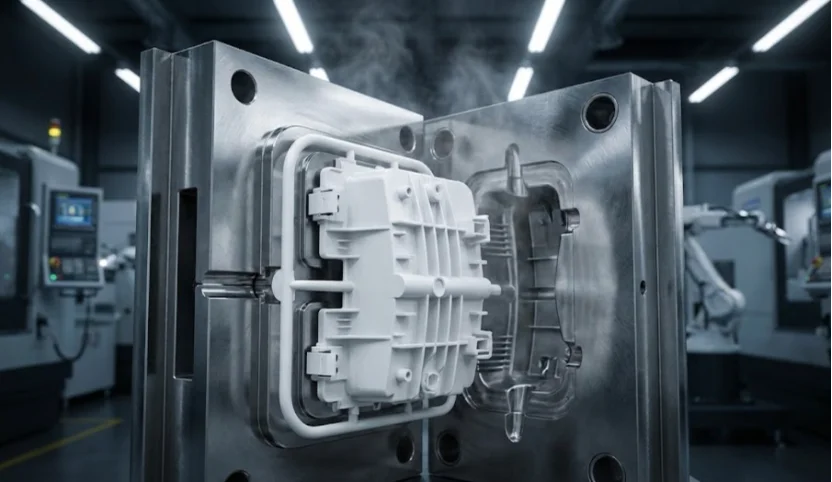
Plastic injection molding components occasionally emerge from production presses bearing cloudy surface whitening, stress blushing, or linear tension scars. Engineers frequently investigate how to get rid of stress marks when transparent electronic covers or dark structural enclosures exhibit localized surface defects.
These visual imperfections indicate severe internal molecular alignment and trapped thermal energy that compromise structural integrity under load. Resolving these superficial blemishes requires a systematic review of machine parameters rather than immediate tooling redesigns. Precision adjustments transform erratic shop-floor outcomes into predictable, repeatable manufacturing workflows.
Diagnosing Shear-Induced Blushing and Molecular Tension
During initial cavity filling, polymer chains stretch violently as they navigate narrow gates, sharp corners, and complex geometric transitions. If melt streams cool prematurely against cold steel walls, these elongated molecular orientations freeze permanently in place.
Technicians frequently analyze these internal stress zones using polarized light equipment to map high-tension regions accurately before modifying machines. Recognizing the precise root cause prevents wasted cycle time, excessive material scrap, and ineffective machinery tampering during production runs.
Material selection also dictates how severely a thermoplastic compound reacts to rapid shear rates and localized pressure spikes during injection. Unfilled resins behave differently under thermal contraction compared to glass-filled or mineral-reinforced alternatives commonly used in industrial housings.
Reviewing raw material technical datasheets helps technical teams select appropriate melt flow indices that minimize internal molecular friction. Matching polymer characteristics to specific cavity designs prevents unexpected blushing during high-speed production cycles.
Calibrating Packing Pressures and Velocity Profiles
Excessive holding pressure remains a primary driver behind stubborn residual stress concentrations within molded plastic housings and mechanical enclosures. High packing forces cram unnecessary polymer volume into closed cavities, locking severe structural tension directly into the material matrix.
Lowering holding pressure incrementally while shortening hold times allows polymer chains to relax naturally without volumetric distortion. Technicians learning how to get rid of stress marks discover that stabilizing shot weight eliminates surface blushing completely.
Injection velocity profiles require careful programming to prevent extreme friction near cavity walls during early filling phases of operation. Rapid injection speeds generate massive shear stress, while sluggish fill rates cause premature freezing and visible flow lines on surfaces.
Programming machines to fill roughly ninety percent of the mold rapidly, followed by gradual deceleration, resolves this processing conflict. Inspecting gate areas under strong light sources verifies whether velocity adjustments successfully eradicated surface whitening.
Managing Thermal Gradients to Release Internal Strains
Cold mold surfaces accelerate cooling rates unevenly across varying wall thicknesses, trapping destructive thermal contraction stresses inside manufactured parts. Raising melt temperatures improves fluid viscosity, allowing polymer chains adequate time to settle before final freeze-off occurs in the cavity.
Elevated mold temperatures eliminate cloudy tension lines, yielding a uniform and aesthetically pleasing exterior finish across batches. HordRT provides comprehensive engineering support to optimize thermal management systems for complex production lines.
Cooling channel efficiency directly influences thermal uniformity and residual stress distribution throughout molded structural enclosures and multi-cavity tools. Blocked or poorly designed cooling lines create localized hot spots that delay solidification in thick wall sections and cause warping.
Cleaning mineral buildup from thermal management systems restores balanced heat transfer across both core and cavity halves. Uniform thermal dissipation minimizes localized shrinkage differentials that generate hidden internal tension lines.
Refining Ejection Mechanics and Tooling Geometry
Component geometries sometimes contribute to localized stress whitening during part extraction from tight steel cavities and deep cores. Parts bind against core surfaces if draft angles are insufficient or if opening speeds are excessively aggressive during stripping.
Increasing draft angles, distributing ejection forces across wider surface areas, and lengthening cooling timers prevent mechanical binding. Production specialists utilizing advanced tooling strategies from HordRT notice that clean ejections eliminate pale stress halos entirely.
Post-molding treatments occasionally offer secondary relief when geometric constraints prevent complete parameter-driven defect elimination on complex parts. Annealing components in controlled thermal environments allows trapped molecular chains to relax without deforming surrounding functional features.
However, relying on thermal post-treatments increases overall manufacturing costs and extends total cycle times significantly. Mastering how to get rid of stress marks through primary parameter tuning remains the most cost-effective industrial strategy.
Collaborating with experienced manufacturing partners streamlines defect troubleshooting and accelerates time-to-market milestones for complex hardware projects. HordRT provides comprehensive engineering support to resolve challenging structural imperfections before mass manufacturing commences.
Leveraging professional expertise eliminates costly trial-and-error cycles on the shop floor. Reliable process optimization guarantees long-term durability and superior cosmetic quality for custom plastic components.
