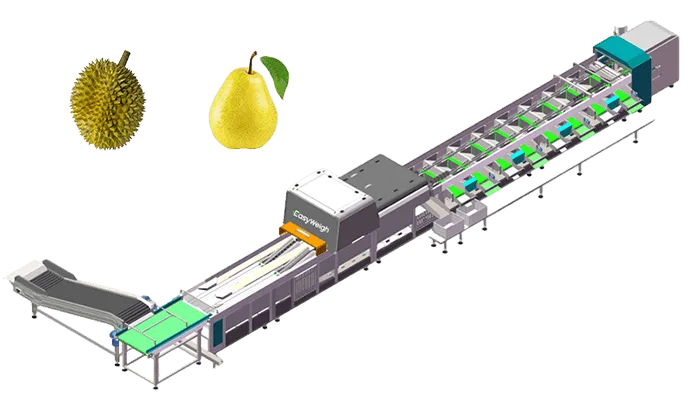
Choosing between an optical sorting machine and weight-based grading should start with a simple question: what characteristic determines whether a product belongs in one category or another?
Weight is useful when products must be divided into defined weight ranges. Vision-based sorting becomes more valuable when color, size, shape, surface defects, or foreign material determine acceptance.
The distinction matters because food processors often face several forms of product variation at once. A fruit may have the correct weight but visible damage, while two products with similar appearance may need different grades because their weights differ. Easyweigh positions both technologies as automated sorting solutions, but their measurement principles address different production requirements.
The First Decision: What Does the Line Need to Measure?
Weight grading relies on physical measurement. Products pass through a weighing process, and the system assigns them to configured categories according to their measured weight. High-precision sensors are used to detect weight variation, making this approach suitable when weight itself is the main grading criterion.
An optical sorting machine approaches the product differently. Cameras and image-processing algorithms inspect visible characteristics rather than relying primarily on mass. The system can evaluate factors such as size, color, shape, and surface defects, allowing processors to separate products according to appearance and quality attributes.
This creates the first major distinction: weight sorting answers “How heavy is the product?”, while optical inspection can answer “What does the product look like?” The correct choice depends on which question matters most to the production specification.
Weight Sorting Answers a Different Question From Vision Inspection
Weight sorting becomes particularly useful when uniform portions or defined weight grades are central to the operation. Seafood, fish, meat, poultry, fruits, and prepared foods can require weight-based classification, especially when products are subsequently packed or sold according to weight categories.
A Weight Sorting system can assign products to multiple categories according to configured weight parameters. That capability is useful for processors dealing with natural size variation, because operators do not have to estimate each item’s category manually.
The value extends beyond classification. Consistent weight groups can simplify downstream packing and reduce unnecessary variation between packages. For products where weight is commercially significant, automated measurement provides a direct link between sorting and production control.
Why Optical Sorting Goes Beyond Weight
An optical sorting machine becomes more relevant when a product’s visual condition cannot be determined from weight alone. A fruit can meet a target weight yet still show discoloration, bruising, abnormal shape, or surface defects that make it unsuitable for a particular grade.
The optical systems described by Weight Sorting combine imaging technology with AI algorithms to analyze characteristics including size, color, shape, and defects. The company’s optical sorting range is designed particularly around fruits and vegetables, with models intended for small-, medium-, and large-sized produce.
Optical inspection can therefore make quality decisions that a scale cannot. For example, potatoes, grapes, apples, peaches, plums, and other produce can require visual classification alongside basic size grading. The technology is especially useful when appearance is closely linked to commercial quality.
The Product Determines Which Technology Has More Value
Product characteristics should drive the comparison rather than the assumption that one system is inherently more advanced. Fish portions and meat cuts may need precise weight classification because portion size directly influences grading or packing. Fruits and vegetables may require visual inspection because external quality can vary independently of weight.
The application list also shows why a single sorting method may not cover every requirement. Weight Sorting describes weight-based solutions for seafood, fish, meat, poultry, and prepared foods, while its optical systems focus on fruit and vegetable inspection and grading.
A processor should therefore define the rejection or grading rule first. If the specification is based mainly on mass, Weight Sorting is the logical starting point. If defects or appearance determine the decision, vision technology becomes more appropriate. Some complex lines may require both types of information.
Integration Matters When Sorting Becomes Part of the Line
Neither technology creates its full value when treated as an isolated machine. Production lines need controlled product flow, consistent inspection, automatic classification, and reliable transfer to the next process.
Both approaches can be integrated into automated production workflows. The optical sorting systems described by Weight Sorting are designed to integrate with existing production lines, including conveyor or washing lines, while its weight-based systems emphasize production-line integration and real-time monitoring.
Real-time information also changes how operators manage sorting. Monitoring can provide visibility into production performance and help teams respond when product characteristics or process requirements change. Automation is therefore not only about replacing manual inspection; it connects measurement with ongoing production control.
Choosing Between the Two Starts With the Quality Specification
The strongest purchasing decision begins with the actual grading rule. If every product must be classified according to weight, a weight-based system directly addresses that requirement. If acceptable quality depends on color, shape, visible damage, or other external characteristics, optical inspection provides information that weighing cannot supply.
Easyweigh supports both approaches, allowing the technology choice to follow the product and process rather than forcing every application into one sorting method. Its published solutions include high-precision weight sensing as well as AI-powered optical analysis for visual characteristics.
The focus of the comparison for food processors should thus be on determining what data the production line needs to collect rather than on determining which equipment is inherently better.
Weight Sorting is strongest when weight defines the grade; an optical sorting machine becomes more valuable when visible quality determines the decision. Where both dimensions influence the finished product, combining measurement methods may provide the more complete automation strategy.
