Maintaining large outdoor spaces has traditionally demanded hours of physical effort, often stretching maintenance teams thin across sprawling campuses, parking facilities, and public walkways. The emergence of the outdoor robot cleaner has begun to shift this dynamic, offering facilities a way to redirect human energy toward more skilled tasks rather than repetitive sweeping routes.
For property managers and facility operators, the question is no longer whether automation can handle outdoor debris, but how much of the daily workload these machines can realistically absorb. Greendorph has developed solutions that speak directly to this operational challenge, with the Auto Sweeper YJ130 serving as a practical example of what modern electric sweepers can deliver.
Rethinking Daily Cleaning Routines
The repetitive nature of daily outdoor sweeping—covering the same paths, emptying bins, and responding to weather-related debris—consumes a significant portion of a maintenance crew’s available hours. When a single outdoor sweeper vacuum can cover 5,760 square meters per hour, the arithmetic becomes difficult to ignore. That kind of coverage means what once required a team working through the morning can now be completed by one machine operating autonomously, freeing personnel to address detailed cleaning needs that robots cannot yet handle. This redistribution of labor does not replace workers; it repositions them.
Beyond raw speed, consistency plays an equally important role. Human sweepers naturally vary in their thoroughness depending on fatigue, weather conditions, or time pressure. An outdoor robot cleaner can follow preset cleaning routes consistently, helping reduce missed areas and the need for repeated manual cleaning simply because the day has been long. For facility managers, this predictability translates into cleaner spaces with fewer complaints and less need for rework.
Autonomous Navigation and Obstacle Handling
One of the primary friction points in outdoor sweeping has always been the need for constant human intervention when obstacles appear. Benches, planters, parked vehicles, and pedestrians all force manual sweepers to pause, adjust, and restart. Modern outdoor robotic vacuum cleaner units address this through sensor-based navigation that detects and routes around barriers without stopping the cleaning cycle. The Auto Sweeper YJ130 incorporates flexible obstacle avoidance as a core feature, allowing it to maintain continuous operation even in moderately crowded environments.
This capability matters because interruptions are where efficiency gains evaporate. A sweeper that stops every few minutes for human redirection quickly loses its productivity advantage over manual methods. When the machine handles its own path adjustments, the operator’s role shifts from constant supervision to periodic monitoring. Live status tracking further supports this arrangement, providing real-time visibility into the machine’s location and progress without requiring someone to follow behind it.
The Shift to Electric Power and Zero Emissions
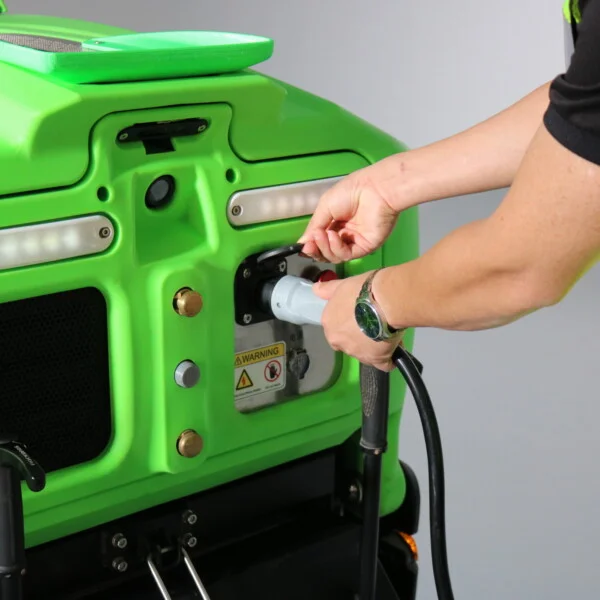
Beyond labor savings, the transition to fully electric outdoor sweeping equipment brings operational and environmental benefits that compound the value proposition. The Auto Sweeper YJ130 runs on 100% electric power, producing zero CO₂ emissions during operation. For facilities operating in urban environments or on campuses with strict air quality requirements, this eliminates the exhaust concerns associated with gas-powered sweepers. Indoor-adjacent spaces like covered walkways or parking structures become viable cleaning zones without ventilation worries.
Electric powertrains also reduce the maintenance burden compared to combustion engines. Fewer moving parts, no oil changes, and simpler drivetrain components mean less time spent on mechanical upkeep and more time spent cleaning. Facility operators often discover that the total cost of ownership for electric sweepers, when factoring in reduced maintenance and eliminated fuel expenses, compares favorably to traditional equipment over the machine’s lifespan. The operational simplicity extends to the user interface as well, with controls designed for straightforward operation that requires minimal training.
Real-Time Visibility and Operational Oversight
The ability to track cleaning progress remotely has become an expectation rather than a luxury in modern facility management. Live status tracking, included with the Auto Sweeper YJ130, provides supervisors with up-to-date information on where the machine is, what areas it has covered, and how much cleaning time remains. This visibility supports better scheduling decisions and allows teams to respond quickly if an area requires additional attention.
For organizations managing multiple sites or large single campuses, this data layer transforms sweeping from a scheduled activity into a verifiable process. Maintenance managers can confirm that designated zones received their cleaning without dispatching someone to physically check each location. The information can also help maintenance managers review cleaning progress and identify areas that may require additional attention, turning the outdoor robot cleaner into both a labor-saving device and a record-keeping tool. When issues do arise—such as unexpected debris from a weekend event—the tracking system helps identify gaps and adjust routes accordingly.
Conclusion
The conversation around outdoor maintenance is gradually shifting from how many people are needed to sweep to how effectively available technology can handle the routine work. Greendorph offers equipment that demonstrates this principle in practice, with the Auto Sweeper YJ130 showing how autonomous operation, electric power, and smart navigation come together to reduce the physical demands on cleaning staff.
The outdoor sweeper vacuum category continues to evolve, and for facilities looking to lower manual cleaning pressure without sacrificing cleanliness, the path forward involves integrating these tools thoughtfully into existing operations. To understand the full scope of what these machines can accomplish, reviewing the capabilities of a modern outdoor robot cleaner provides a useful starting point for any facility considering the transition.
