Every optical link begins with a control problem: an electrical data stream must be imposed on light in a form that can survive transmission and be recovered accurately. When they evaluate this process, they focus on how precisely the optical carrier is changed, how much power is lost, and whether the modulation remains stable across frequency and operating conditions.
A modulator can vary intensity, phase, or both, depending on the communication format. That choice affects the receiver, digital signal processing, reach, and wavelength plan.
They therefore treat modulation as part of the link architecture rather than a separate component decision, because improvements at the device level must be measured against their impact on the complete network. Today’s photonic applications require control over faster signals and more densely packed channels.
A well-designed fiber optic modulator gives engineers a defined interface between high-speed electronics and the optical domain, enabling repeatable signal generation for data transmission, component characterization, polarization work, and system-level verification.
Translating Electrical Data into Controlled Light
The conversion starts when an electrical field changes the refractive index of an electro-optic material. In a Mach-Zehnder structure, that phase change becomes a controlled variation in output intensity.
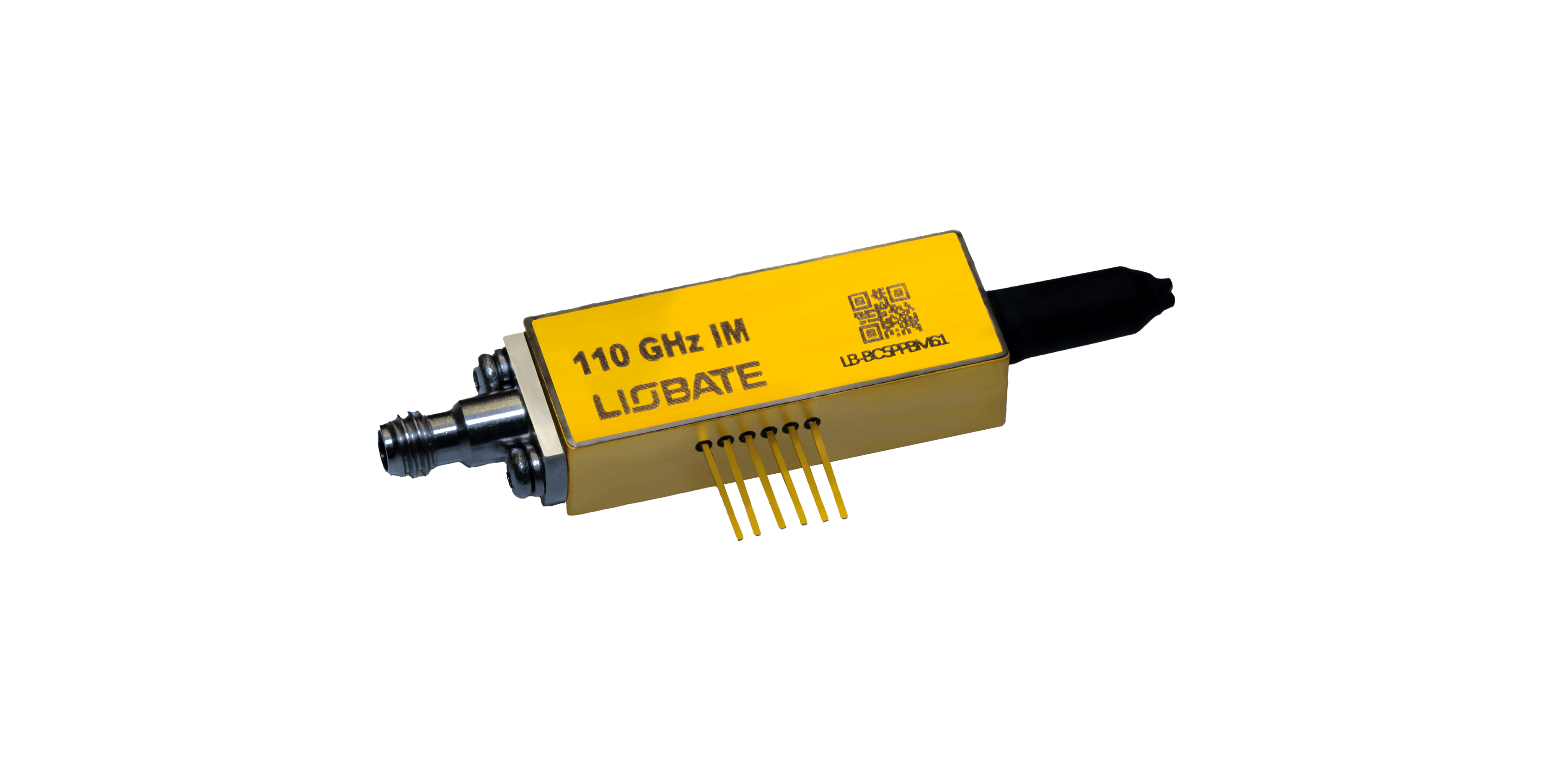
They value this approach because the transfer function can be engineered for different formats, while the optical waveguide and electrode design determine bandwidth, efficiency, and usable operating range. The TFLN devices described by Liobate emphasize high electro-optic bandwidth and low insertion loss.
Those attributes matter in photonic applications because a broad response supports faster symbol rates, while lower loss leaves more optical power for transmission and detection. Neither metric works alone; the driver, package, fiber coupling, and receiver must preserve the same operating margin. Control also includes bias management.
A fiber optic modulator must operate at the intended point on its transfer curve, and drift can change extinction ratio or introduce distortion. They look for bias-stability data, monitoring options, and realistic temperature behavior so that system designers can decide whether active control is needed and how it should be implemented.
Protecting Signal Quality Across the Optical Path
Once light enters the network, signal integrity is influenced by dispersion, noise, filtering, reflections, and channel crosstalk. Modulation quality determines how much margin is available to tolerate these effects.
In high-speed links, they assess the frequency response and linearity of the device together, because a wide bandwidth with irregular amplitude or phase response can still degrade the transmitted waveform.
Measurement is another major use. Liobate lists OEO conversion, polarization measurement and control, frequency identification, and coherent-system validation among relevant photonic applications.
In these environments, the modulator becomes a calibrated signal-generation tool, so repeatability and traceable characterization may be as important as the upper supported data rate. A suitable fiber optic modulator can also help engineering teams compare network architectures before final hardware is available.
By generating controlled intensity or phase patterns, the team can examine receiver tolerance, equalization strategies, optical filtering, and link penalties. This reduces uncertainty during development and gives component suppliers clearer acceptance criteria.
Selecting and Validating a Modulator for Deployment
Selection should begin with the operating wavelength and required modulation format, followed by bandwidth, insertion loss, half-wave voltage, extinction ratio, package interface, and optical power handling. They also consider connector type, polarization requirements, termination, and bias method.
These details often determine whether a device fits an existing test bench or module design without costly adaptation. For production programs, consistency across units matters more than a single best-case result. A fiber optic modulator should be evaluated through statistical sampling, environmental testing, and repeated connection cycles where relevant.
Photonic components deployed in communication hardware demand strict change control, full traceability, and standardized workflows to address parameter drift between engineering prototypes and mass-production batches. Liobate’s TFLN devices designed for communications and test measurement applications cover the 70–110 GHz bandwidth range. This bandwidth specification is adopted only as an initial reference benchmark rather than a conclusive full qualification metric.
The packaged response, optical loss, drive conditions, and target waveform still need to be measured in the customer’s configuration before a design decision is finalized. During integration, they also coordinate optical and electronic simulation.
The driver team needs realistic impedance and voltage targets, while the receiver team needs expected modulation depth and noise. Sharing measured device data across these groups helps them identify margin early and prevents late redesign of boards, packages, or control firmware. From a purchasing viewpoint, a suitable modulator is the one that reduces total integration risk.
A lower drive voltage may simplify electronics, lower loss may improve the power budget, and improved linearity may reduce signal penalties. Each advantage should be converted into a system benefit that engineering, sourcing, and operations teams can verify with the same data. They also avoid assuming that one modulator fits every link.
Short-reach modules, coherent telecom equipment, laboratory instruments, and sensing systems place different demands on packaging and control. A disciplined selection process begins by identifying the required parameters, then uses optional capabilities where they create a measurable improvement.
A sourcing decision for modulation hardware should connect device data with driver design, package loss, qualification, and lifecycle cost. Engineers can evaluate Liobate under the same acceptance plan used for alternative suppliers. That approach keeps the discussion focused on integration risk and repeatable network performance.
