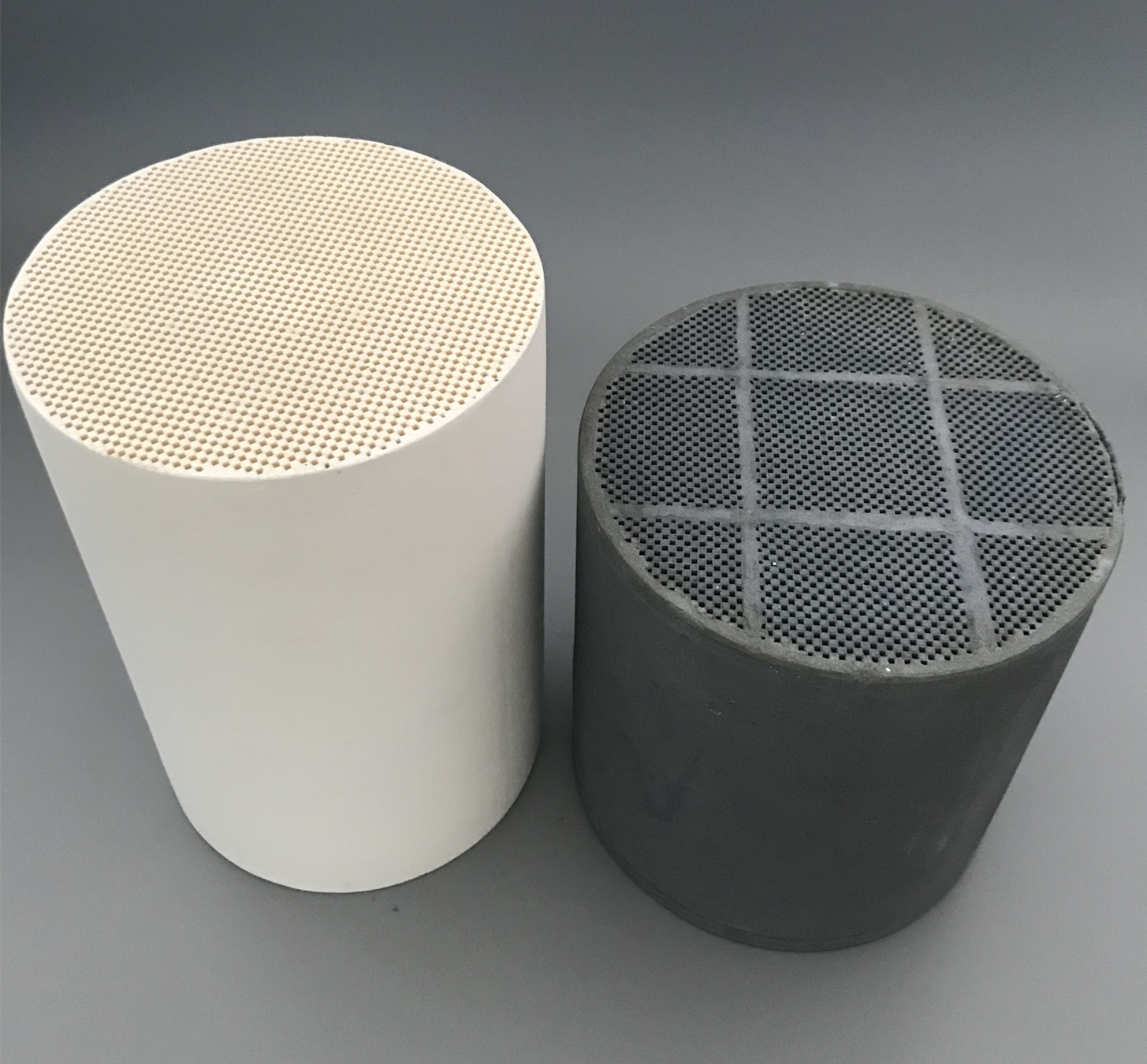
Follow two constituents through a diesel exhaust stream and their different treatment paths become clear. Nitrogen oxides remain gases that require a chemical reaction. Soot consists of particles that can be retained by a filter. Selective catalytic reduction and a diesel soot filter address these problems through distinct mechanisms, even when both devices appear inside one exhaust assembly.
The distinction matters because a successful NOx measurement says nothing by itself about particulate capture, and a clean-looking filter outlet cannot establish NOx conversion. Temperature, NO/NO₂ balance, ammonia supply, soot loading, and regeneration determine whether each process is available when the engine runs. The two pathways should be traced separately before the system result is judged.
Trace the Nitrogen Oxides through SCR
Urea dosing supplies ammonia for reactions that reduce NOx to nitrogen and water over an SCR catalyst. The proportions of nitric oxide and nitrogen dioxide influence the route by which those reactions proceed. Standard SCR and fast-SCR pathways are often distinguished by that balance. Neither name guarantees a fixed conversion percentage over every exhaust temperature or dosing condition.
Ammonia availability creates another operating boundary. Inadequate dosing can leave NOx unconverted, while excess dosing raises a different control problem. The catalyst also needs sufficient temperature and contact time. A selective catalytic reduction design must combine chemistry with dosing strategy and exhaust flow rather than rely on a substrate specification as a complete answer.
In a typical comparison, inlet and outlet NOx readings need to be paired with reductant flow and exhaust temperature. A lower outlet concentration at one point may reflect a warmer catalyst or a different dose rather than a different formulation. Keeping those variables visible helps locate the cause of a change without assigning every improvement to the active material itself.
Follow Soot into the Wall-Flow Channels
Particles move with the exhaust until the filter forces the gas through porous walls. Soot is deposited on or within those walls, while cleaned gas leaves the channels. This is a physical separation step, not the SCR reaction taking place at the adjacent catalyst. Filter geometry, wall properties, and accumulated soot determine how pressure changes during operation.
Soot accumulation cannot continue without limit. Under favorable exhaust conditions, stored soot oxidizes passively; active regeneration supplies heat when that natural route fails. The filter’s pressure trend helps show whether regeneration restores usable flow capacity. A filter that retains particles but cannot complete the planned regeneration cycle may impose an unacceptable engine burden.
Pressure readings tell a different story. As soot collects, the filter’s resistance may rise even if particulate capture remains high. A later reduction in pressure after regeneration indicates that some deposited soot has been removed, but it does not by itself prove that every channel is intact. Capture and pressure measurements are complementary checks of the wall-flow structure.
The diesel soot filter range described by Hualian Catalyst uses Cordierite or SiC wall-flow materials. Material choice is relevant to thermal and mechanical demands, while the shared wall-flow principle explains why particles are retained. Capture and pressure behavior should be measured on the intended configuration; neither the presence of a porous wall nor a material name establishes a universal installed result.
Diagnose Weak Intervals on Engine Cycles
Engine-cycle records can align SCR and DPF measurements on a common timeline without merging them into one score. Engine load and exhaust temperature anchor the record; NOx concentration, reductant dose, filter pressure, and regeneration state retain their separate meanings. That arrangement shows whether a weak interval is chemical, filtration-related, or caused by operating conditions shared by both devices.
The NO/NO₂ ratio provides the link between inlet measurements and the standard and fast-SCR pathways described in Hualian’s diesel SCR information. Available reduction formulations encounter the mixture actually entering the unit.
A change in that mixture can alter which pathway contributes during a change in engine load, making an SCR inlet measurement more informative than a prediction from the device name.
The NOx pathway is evaluated through inlet and outlet concentrations under stated temperature, dosing, and flow conditions. The diesel soot filter pathway is evaluated through capture, loading, pressure rise, and regeneration outcomes. Both may change as engine duty shifts, but not for the same reason. Treating them as one undifferentiated “emissions efficiency” figure would hide the source of a weak result.
The NO/NO₂ balance may vary across operating points, altering SCR reaction behavior. At the same time, repeated low-temperature periods may allow soot to build up before regeneration becomes possible. These events may coexist, yet an adjustment intended to improve one cannot be assumed to correct the other. Distinct sensors and test records are needed to interpret the combined system.
Results from the same engine cycle tell two different stories: one about gaseous NOx, the other about captured and removed soot. The operating record for a proposed system must show both pathways under the same engine duty across changing loads. Aligned records reveal whether engine load, reductant delivery, filter restriction, or regeneration state explains a weak operating interval in the installed system.
