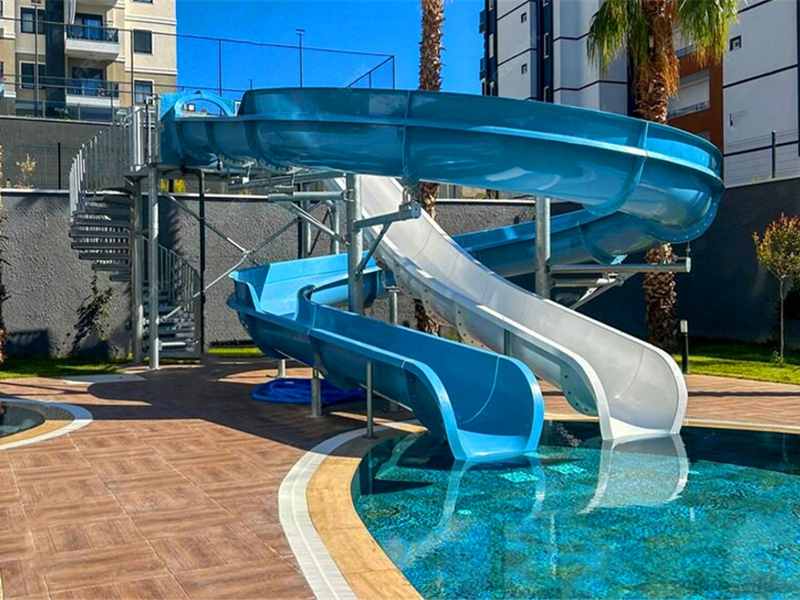
Changing a slide’s colour is not the same decision as changing its curve. Both may appear on a customisation request, yet one concerns the visual finish while the other can alter the route, support positions and landing arrangement. The choices need different kinds of information.
For custom pool slides for inground pools, a specification separates desired appearance from the dimensions and operating conditions that constrain the design. Shapes, heights and colours can then be developed together without treating every preference as an independently adjustable option.
Describe the Movement before Drawing the Shape
An open descent, an enclosed section and a spiral do not offer the same sequence of views and movement. Describing the intended experience gives the designer more useful direction than requesting an unusual outline. The route must still connect its starting point with a workable landing arrangement.
Curves occupy space around the pool as well as along the sliding surface. A broad turn and a compact turn imply different geometry, so changing the radius is not simply a cosmetic edit. The relationship between the route, supporting structure and surrounding circulation needs to be reconsidered.
A water park manufacturer needs to understand which elements of the brief are fixed and which can move. An existing pool edge may be fixed, for example, while the platform position remains open to discussion. That distinction creates room for design without assuming that every boundary is negotiable.
Ride format belongs in the same conversation. An individual body slide and a shared raft attraction require different equipment arrangements and offer different experiences. A reference photograph can communicate a preference, but it does not establish that the photographed configuration will fit another site.
Treat Height as Part of a Three-Dimensional Layout
Starting height describes a vertical dimension, not the complete scale of an installation. The platform, stairs, route and endpoint must be considered together. A design can fit within the available height while still placing supports where the poolside plan cannot accommodate them.
A higher start creates a larger vertical drop only if the endpoint stays unchanged. Height does not specify ride speed by itself: slopes, curves and transitions shape the descent. The design therefore needs an engineered route rather than a starting level considered in isolation.
The design brief for custom pool slides for inground pools therefore needs more than the total plot area. Pool dimensions, level changes and the usable space around fixed structures reveal where the route can start and finish. These constraints make a height request meaningful.
Jinchao offers different configurations rather than one universal height solution. Its stainless steel model has a starting-height range of 2–8 m and a 0.8 m flume for a single rider. Those dimensions describe that model; they are not a general specification for every bespoke slide.
Its U-shaped fibreglass option instead uses a double raft and an 8–12 m starting height. Curve radius and landing layout can be customised for the project. The comparison illustrates why a preferred height must be attached to a defined ride format before the design is developed further.
Choose Colours in Their Architectural Setting
Colour decisions become more precise when the surrounding buildings and landscape are included. A palette viewed alone cannot show whether a slide will blend into a resort setting or stand apart as a landmark. The desired relationship with its surroundings is part of the brief.
A theme also needs more definition than a single label. Repeated shapes, selected colours and a consistent treatment of entrances can establish a recognisable identity without giving every surface the same decoration. The visual choices then have a purpose beyond making the slide conspicuous.
Jinchao develops designs from site dimensions or CAD drawings and can prepare a colour plan for approval. Working with a water park manufacturer at this stage connects the proposed finish with the equipment configuration, rather than leaving colour as an instruction added after the geometry is settled.
Decorative treatment still has physical limits. Covers and themed features cannot be considered separately from the joints and components that require access. A coordinated design preserves the intended appearance while keeping the underlying attraction available for inspection and routine attention throughout its service life.
Turn Preferences into an Agreed Specification
A request distinguishes the preferred experience, fixed site dimensions and visual priorities. It also identifies decisions that remain open. The proposal can then show which combination is practical instead of presenting a list of apparently unlimited customisation options with no relationship to the pool.
The cost implications of custom pool slides for inground pools follow the actual configuration. Additional transitions, enclosed sections or elaborate forms can change fabrication work, joints and support requirements. Comparing routes by length alone misses those differences, even when the alternatives use similar colours.
Before manufacture, the water park manufacturer and project team need an agreed arrangement that brings the route, dimensions and finish together. Jinchao’s concept and three-dimensional layout work provides a setting for that discussion. Approval is more useful when it identifies the configuration being accepted, not only an attractive image.
Customisation succeeds when the specification explains how the slide fits the site and what experience it will provide. An approved drawing can then show the route, its starting level, its landing arrangement and its colour scheme as one coordinated design.
